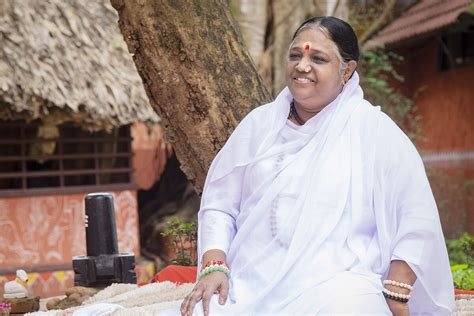
Amma: Mata Amritanandamayi Devi — A Life of Love, Service and Spiritual Awakening
Among the most internationally recognized spiritual figures to emerge from Kerala in modern times is Mata Amritanandamayi Devi, affectionately known throughout the world simply as Amma — Mother.
For millions of people, Amma represents compassion, devotion and selfless service. Her life has inspired a worldwide humanitarian movement, while her ashram at Amritapuri has become a place where people come for meditation, prayer, spiritual practice and seva. Her path is particularly interesting because it demonstrates that spirituality does not have to remain separate from ordinary human life. It can become service. It can become compassion. It can become a way of seeing the Divine in another human being.
Who Is Amma?
Mata Amritanandamayi Devi was born in 1953 in the coastal village of Parayakadavu in Kerala. From a young age, she became deeply immersed in devotion and spiritual practice. Her childhood was not presented as the beginning of a conventional spiritual career. Rather, her life gradually developed around devotion, compassion and service.
As she grew older, people began approaching her for spiritual guidance. Her affectionate embrace became one of the most recognizable expressions of her spiritual work. She became known worldwide as Amma, meaning Mother. Her message was remarkably simple:
Love. Serve. See the Divine in others.
For a world often fascinated by complicated spiritual philosophies, this simplicity is one of the most powerful aspects of her teaching.
The Meaning of the Divine Mother
The name Amma carries an important spiritual meaning. In Indian devotional traditions, the Divine is often approached through different relationships. God can be experienced as father, friend, teacher. As beloved. And as mother.
The mother relationship is especially intimate. A mother does not need philosophical arguments to care for her child. She simply loves, regardless of the circumstances and behaviours. The body and soul that grief inside of a mothers womb, born through excruciating pain only to then being completely dependent on the mother for the first year is so special that a mothers love is incomparable to any other love, regardless of gender.
Amma’s spiritual identity grew around this principle of unconditional maternal love. Her teachings repeatedly return to compassion, forgiveness, humility and service. Love, in this context, becomes a discipline. To love another person requires patience. To serve requires humility. To forgive requires strength. And to see divinity in another person requires us to look beyond surface differences.
Amritapuri: The Ashram by the Arabian Sea
Amma’s main ashram, Amritapuri, is located in Kerala, near the Arabian Sea. The ashram has developed into a large spiritual and humanitarian community where residents and visitors participate in meditation, devotional singing, prayer, service and other activities.
For someone living or practising yoga in Kerala, Amritapuri represents an important part of the contemporary spiritual landscape of the state. Its location also creates a beautiful geographical connection with the wider coastal environment of Kerala.
Varkala and Amritapuri belong to a region where the sea, temples, ashrams and spiritual traditions coexist. Students who come to Shiva Rishi Yoga therefore have an opportunity not only to study yoga but to encounter the living spiritual culture of South India.
Amma and Seva
One of the central ideas associated with Amma is seva, or selfless service. In yoga, seva is important because it changes our relationship with action. Ordinary action often asks:
What will I receive?
Seva asks:
What can I give?
This shift is central to Karma Yoga, the path of selfless action described in the Bhagavad Gita. The action itself may be simple. Cooking, Cleaning, Teaching, Caring for someone who is sick, Helping a stranger, Feeding another person. The spiritual transformation occurs through the intention behind the action.
When we act without constantly seeking recognition, reward or personal advantage, the ego becomes less dominant. This is why seva is not merely charity. It can become a spiritual practice.
Amma’s Humanitarian Work
The organization associated with Amma, the Mata Amritanandamayi Math, has developed extensive humanitarian initiatives in India and internationally. These include activities in areas such as healthcare, education, disaster relief, housing, environmental work and support for disadvantaged communities.
The humanitarian organization Embracing the World has also presented Amma’s service activities internationally. Whatever one’s personal spiritual beliefs may be, this aspect of Amma’s work demonstrates an important principle:
Spirituality can be measured not only by what happens during meditation, but also by how we respond to suffering. A person may sit peacefully for an hour. But can that peace influence how they treat another person? That is the deeper test.
Amma and Bhakti Yoga
Amma’s path is strongly connected with Bhakti Yoga, the yoga of devotion. Bhakti does not require intellectual mastery. It begins with the heart. Through chanting, prayer, remembrance, surrender and love, the practitioner gradually shifts attention away from the limited individual self.
Devotion can take many forms. Some people pray to Shiva. Some worship Devi. Some follow Krishna. Some meditate upon the formless Absolute. The outer form may differ, but the inner movement can be similar:
From separation toward connection. From ego toward surrender. From fear toward love.
The Hug as a Spiritual Gesture
Perhaps the most recognizable feature of Amma’s work is her embrace. Over the decades, she has embraced millions of people. The gesture is simple. There is no complicated philosophy required. A person approaches. Amma embraces them. For many people, this has become a deeply emotional spiritual experience. The embrace can also be understood symbolically. A hug removes distance.
For a moment, the distinction between “teacher” and “student,” “stranger” and “friend,” becomes less important. The gesture communicates something that philosophical language sometimes struggles to express: You are seen. You are accepted. You are not alone.
Whether one interprets the embrace spiritually, psychologically or simply humanly, its significance lies in its radical simplicity.
Amma and the Divine Mother
The connection between Amma and the Divine Mother tradition becomes especially meaningful when we remember the role of Shakti in Indian spirituality.
The Divine Mother is not only an image on a temple altar. She can also be understood as compassion itself. As nourishment.As strength. As protection. As transformative energy.
This connects naturally with the symbolism of Kali.
At Amritapuri, devotional life includes worship of the Divine Mother, including a temple dedicated to Kali. Kali represents the fierce power of transformation.
Amma’s public teaching emphasizes the compassionate expression of motherhood. Together, these two dimensions offer a rich understanding of Shakti.
The Mother can be gentle, fierce, nourish, remove what is harmful, embrac eus or challenge us to become a better version of ourselves.
Amma and Meditation
Although Amma is widely known for devotion and service, meditation is also part of the spiritual environment surrounding her teachings. Meditation creates the inner foundation from which compassionate action can arise. Without inner awareness, service can become another form of ego.
We may help others while secretly wanting praise. We may give while expecting recognition. We may become “spiritual” while becoming more attached to our spiritual identity.
Meditation reveals these subtle patterns. This is why the combination of Dhyana, Bhakti and Seva is so powerful. Meditation transforms the inner world. Devotion softens the heart. Service brings that transformation into everyday life.
A Simple Practice Inspired by Amma
One does not need to live in an ashram to practise the spirit of Amma’s teachings. Begin with one simple intention:
Today, I will consciously help one person without expecting anything in return.
It might be a small action. Listen carefully to someone. Offer food. Help someone who is struggling. Speak kindly. Forgive someone. Clean a shared space without waiting to be asked. The action itself may appear insignificant. But the attitude transforms it. This is the essence of seva. The spiritual life is built through thousands of small actions.
Amma and the Guru Tradition
The word Guru is often misunderstood. A guru is not simply a person who gives information. Traditionally, the guru is a spiritual teacher who points the student toward a deeper understanding of reality. Different traditions understand the guru relationship differently.
Some emphasize direct transmission.
Some emphasize scripture.
Some emphasize meditation.
Some emphasize devotion.
Some emphasize service.
The important principle is that the teacher helps the student move beyond limited understanding.
At Shiva Rishi Yoga, we approach the guru tradition with respect while also encouraging students to develop their own discernment. A genuine spiritual path should not demand that a student stop questioning. Instead, it should help the student develop deeper awareness.
Amma as a Contemporary Spiritual Teacher
Amma’s significance in modern spirituality is partly that she has brought an ancient language of devotion into a contemporary global context. She speaks to people from many countries, cultures and backgrounds.
Her humanitarian work operates on a global scale. Yet the foundation of the message remains remarkably traditional:
Love more. Serve more. Give more.
This is perhaps one of the most important lessons for modern yoga practitioners.
We can study anatomy, perfect asana, pranayama memorise Sanskrit philosophy and focus on a sattvic/vegetarian/vegan diet. But if these practices do not make us more compassionate, something essential is missing. Yoga should gradually change the way we live.
From Kali to Amma
Our exploration of Kali provides an important doorway into understanding Amma.
Kali represents the transformative power of the Divine Mother. Amma represents, in her own contemporary spiritual expression, the compassionate embrace of the Mother.
The connection is not that Amma should simply be identified with the goddess Kali. Rather, both belong to a wider Indian spiritual culture in which Shakti — divine feminine power — can appear through many forms and qualities.
The fierce Mother teaches courage. The compassionate Mother teaches love. The healing Mother teaches care. The wise Mother teaches discernment. And the spiritual Mother reminds us that consciousness is not merely an intellectual idea. It must become lived experience.
The Connection to Shiva Rishi Yoga
At Shiva Rishi Yoga in Varkala, we study yoga as a complete way of life. Asana is important. Pranayama is important. Meditation is important. Philosophy is important. All is part of our daily curriculum. But so are kindness, humility, awareness and service.
This is why teachers such as Amma are relevant to our understanding of yoga. Her life demonstrates another dimension of the yogic path. Yoga does not always look like sitting alone in a Himalayan cave.
Sometimes it looks like feeding someone, listening to our fellow students, giving without expecting anything, embracing someone who feels forgotten. Sometimes yoga is simply choosing love when the ego wants separation.
At Shiva Rishi Yoga in Varkala, we honour Amma as one of the modern spiritual teachers connected with the wider yogic and devotional culture of Kerala. We hold a deep personal, inner connection to her and seek her guidance during difficult times. Shiva’s very own Mala was blessed by her many years ago and it is one of his most sacred spiritual item.
Only one time he lost it-during a time of confusion when his daughter was born far away in the Netherlands. Once he opened his heart towards his daughter – the mala magically reappeared, as if Amma herself made him aware of the importance of parental love toward your own offspring-regardless of the circumstances.
A Final Reflection
Perhaps the greatest teaching associated with Amma is also the simplest:
Love should become action.
If we meditate but remain indifferent to suffering, our meditation is incomplete. If we study yoga but become more judgmental, our knowledge has not yet become wisdom.
If we speak about consciousness but cannot be kind to the person standing beside us, there is still work to do. The spiritual path is measured through transformation.
Agastya represents an ancient stream of yogic and Siddha wisdom.
Kali represents the transformative power of Shakti.
Shiva represents consciousness.
And Amma reminds us that spiritual realization must ultimately find expression through love and service.
At Shiva Rishi Yoga, we honour these different streams not as separate islands, but as parts of the vast spiritual landscape of India.
Yet the sincere seeker keeps returning to the same fundamental questions:
Who am I?
What is consciousness?
How can I live with greater awareness?
How can my practice benefit others?
And perhaps, ultimately:
How can I transform my own life so that my presence becomes a source of peace for others?
This is where yoga becomes more than a practice. It becomes a way of living.
Om Amriteshwaryai Namaha.
May the Mother guide us toward greater compassion, wisdom, selfless service and inner freedom.