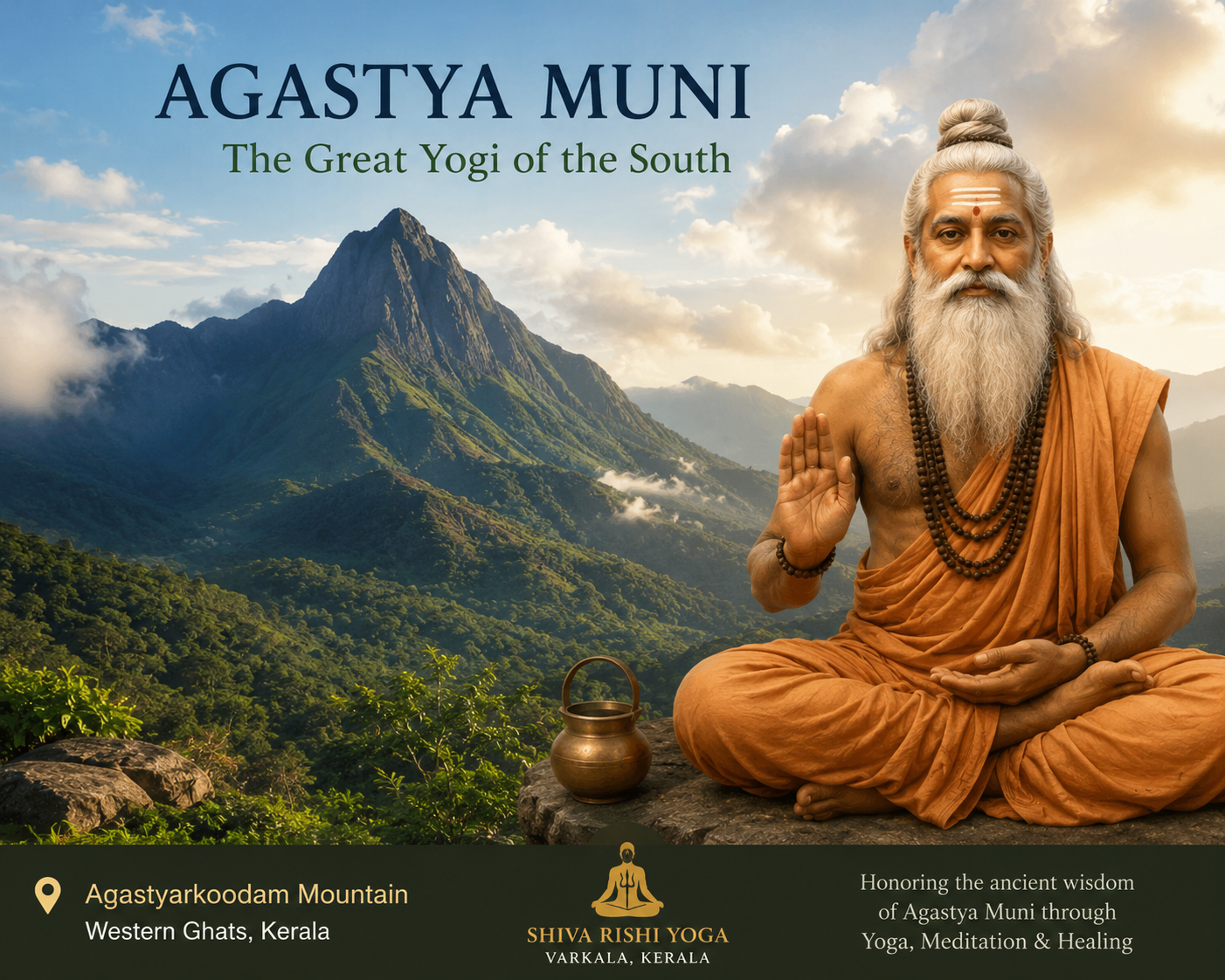
Agastya Muni: The Great Yogi of the South
At Shiva Rishi Yoga in Varkala, we honor the ancient masters who preserved the wisdom of yoga for future generations. One of the most respected among them is Agastya Muni, known as the father of the Siddha tradition.
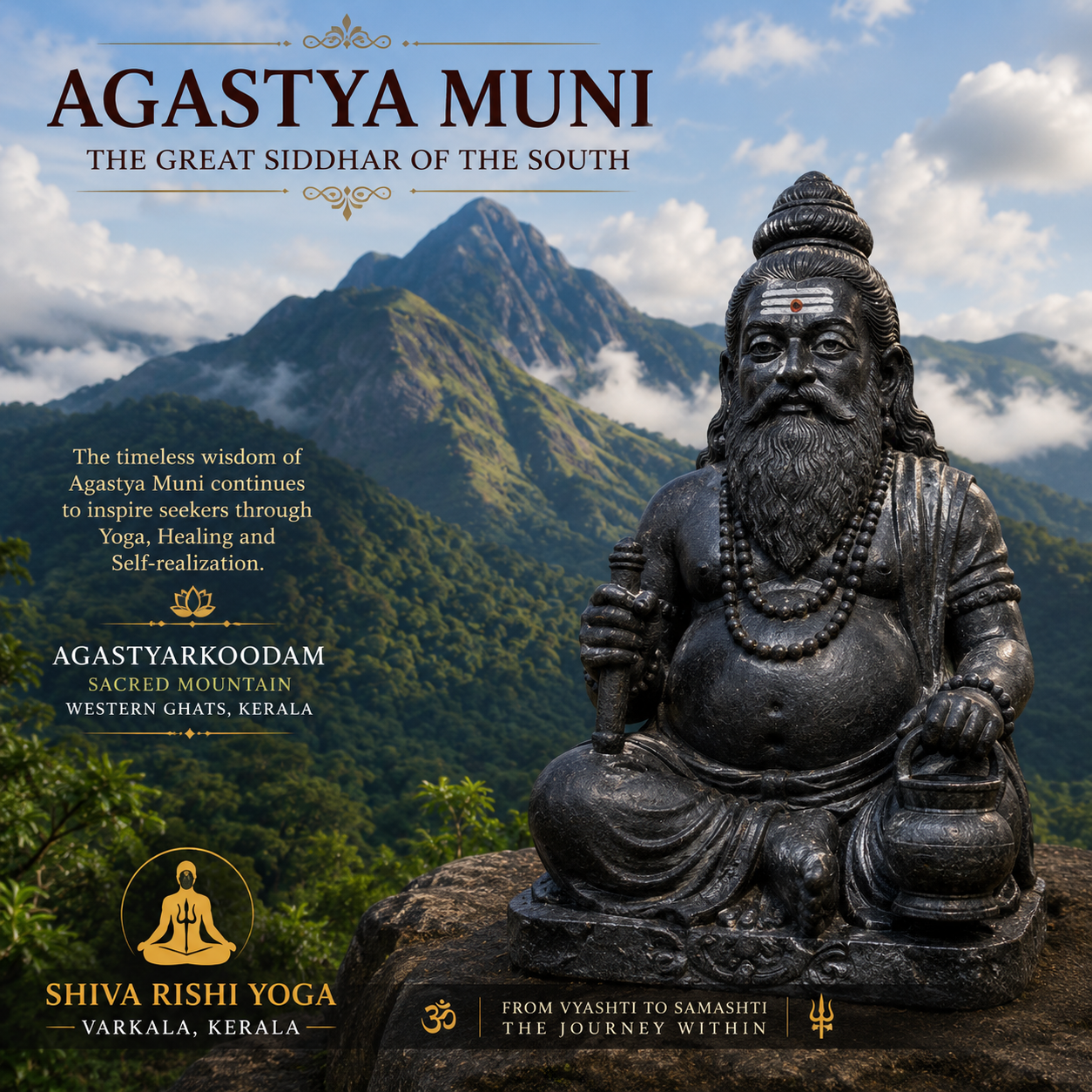
According to Indian tradition, Agastya was a great yogi, healer, and spiritual teacher. Thousands of years ago, he travelled from the northern regions of India to the South. It is said that he came to bring balance, wisdom, and spiritual knowledge to this part of the country. Kerala has a special connection with Agastya Muni through the sacred mountain known as Agastyarkoodam, located in the Western Ghats near Thiruvananthapuram. Many people believe that he meditated in these mountains and shared knowledge about yoga, herbs, healing, and conscious living.
Even today, Agastyarkoodam is considered one of the most sacred mountains in South India. The forests around the mountain contain many rare medicinal plants and are known for their natural beauty and peaceful energy.
A Mountain of Medicinal Plants
Agastyarkoodam, also known as Agasthyamalai, rises in the southern Western Ghats near Thiruvananthapuram. The mountain forms part of one of the richest biodiversity regions of South India. The Agasthyamalai hills are home to hundreds of medicinal plant species, including plants that have been used traditionally in Ayurveda, Siddha and other systems of indigenous medicine. A CCRAS publication dedicated to the region describes approximately 800 medicinal plant species and documents an important selection of them in its herbal guide.
Among the plants associated with the wider Agasthyamalai region is Arogyapacha, scientifically known as Trichopus zeylanicus. The name Arogyapacha can be understood as the “green of health.” The Kani indigenous communities of the Agasthyamalai forests traditionally used the plant during long journeys through the forest, particularly for stamina and vitality. Modern research has subsequently investigated its phytochemistry and possible adaptogenic, antioxidant and other biological properties.
The story of Arogyapacha is especially interesting because it demonstrates something central to the Siddha worldview: knowledge of nature was not simply theoretical. Plants were observed, experienced and passed from one generation to another.
Ethnobotanical research among Kani communities in the Agasthyamalai region has documented dozens of plants used traditionally for different purposes. One study recorded 76 species used as ethnomedicine, illustrating the depth of botanical knowledge preserved among communities living in and around these forests.
The region also contains rare and endemic species. Scientific botanical records include plants whose distribution is restricted to Agasthyamalai, demonstrating how unique this ecosystem is.
This is one reason the story of Agastya feels so naturally connected to the landscape. The mountain is not merely a backdrop to a spiritual legend. It is itself a living expression of the relationship between humans, plants, animals, water, soil and consciousness. For a yogi, the forest becomes a guru.
The changing seasons teach impermanence.
The rivers teach movement.
The mountains teach steadiness.
The plants teach patience.
And silence teaches the mind to listen.

Agastya and the Siddha Tradition
Agastya occupies a particularly important position in the South Indian Siddha tradition. Kerala’s Department of Indian Systems of Medicine describes Agasthiyar as the father of Siddha medicine and explains that the Siddha tradition brought together medicine, yoga, knowledge and practices concerned with preserving the body as an instrument for spiritual realization.
In many modern interpretations, yoga is presented primarily as a system of physical exercise. The Siddha perspective offers a much broader understanding. The body is not something to reject or neglect. It is something to understand, purify and care for because it can become a vehicle for higher awareness.
The Siddha tradition therefore developed several interconnected areas of practice, including:
- Yogam — yogic discipline and meditation
- Vaithiyam — traditional medicine
- Kayakalpam — practices concerned with rejuvenation and longevity
- Varma — knowledge and stimulation of vital points
- Nadi — traditional pulse examination
- Gnana — spiritual knowledge and realization
- Vatham — alchemical traditions
This gives us a deeper way to understand Agastya. He is not remembered simply as a person who taught a particular yoga posture or technique. He represents an entire vision of life in which body, breath, mind, nature and consciousness are interconnected.
The Yogic Practices Associated with Agastya
Traditional literature attributed to Agastya contains discussions of several dimensions of yoga. The Agastya Samhita, for example, contains sections concerning yama and niyama, asana, pranayama, pratyahara, dharana, dhyana and samadhi — the eight limbs of yoga as traditionally derived from Patanjali’s teachings. In this understanding, physical practice is only one part of a much larger journey. This is particularly relevant to the philosophy of Shiva Rishi Yoga.
Yoga begins not with complicated physical movement but with how we live.
Yama concerns our relationship with the world.
Niyama concerns our relationship with ourselves.
Asana develops steadiness in the body.
Pranayama refines the movement of prana.
Pratyahara turns awareness inward.
Dharana develops concentration.
Dhyana becomes meditation.
Samadhi points toward profound absorption and realization.
Pranayama and the Mastery of Prana
In yogic philosophy, breath is closely connected with prana, the vital force. When the breath is disturbed, the mind tends to become disturbed; when the breath becomes steady, the mind can gradually become steady as well. The Agastya Samhita contains detailed discussions of pranayama and describes the practice as part of the path toward mastery of the mind and deeper spiritual realization.
Some later Siddha and yogic traditions also associate Agastya with Vasi Yoga, a subtle form of breath-centered practice. These traditions describe the breath not merely as something entering and leaving the lungs, but as a doorway through which consciousness can become refined.
This should not be understood as simply “breathing exercises.” For the traditional yogi, pranayama was a disciplined practice involving posture, awareness, concentration, breath regulation and ethical preparation. The objective was not to hold the breath for as long as possible. The objective was to become master of one’s own inner movement or the conscious movement of one’s own prana within their body.
When the breath becomes quiet, the senses become quieter.
When the senses become quieter, the mind becomes more stable.
When the mind becomes stable, awareness can turn inward.
This is the deeper logic behind pranayama.
Agastya, Kayakalpa and the Search for Longevity
Another important aspect of the Siddha tradition is Kayakalpa, often translated as rejuvenation or transformation of the body.
The Siddhars explored the relationship between food, herbs, breath, discipline, cleansing, meditation and longevity. The purpose was not simply to live longer for the sake of worldly enjoyment. The body was considered a valuable instrument for spiritual practice.
If the body is weak and constantly disturbed, deep meditation becomes difficult. Therefore, caring for the body could itself become part of spiritual discipline. The longer someone lives, the more karma s/he can release.
This perspective also explains why medicinal plants occupy such an important place in the traditions associated with Agastya. Plants were not viewed only as commodities or ingredients. They were part of the larger intelligence of nature. The Siddha physician therefore needed to understand not only the plant but also its environment, qualities, preparation, timing and relationship with the human body.
Kerala’s Department of Indian Systems of Medicine describes Siddha pharmacology as including medicinal plants, minerals and substances of animal origin, while also emphasizing diet, seasonal routines and ethical living. This holistic approach feels remarkably close to the original spirit of yoga.
Agastyarkoodam: Where Nature Becomes the Teacher
There is something deeply symbolic about Agastya being associated with a mountain covered in forests, herbs and streams.
Mountains have always occupied an important place in Indian spiritual traditions. They offer solitude, distance from ordinary life and an environment where the senses naturally become quieter.
The forests of the region are extraordinarily diverse, and conservation research has identified numerous medicinal species requiring protection from overharvesting and habitat loss. If yoga teaches us that we are connected with nature, then protecting nature becomes part of yogic living. The human body cannot be separated from the food, water and air that sustain it.
The ancient yogic vision therefore becomes ecological as well as spiritual.
To honour Agastya today does not mean simply worshipping his name, but worshipping nature itself and dive deeper into a yogic practice that is not exclusively focused on asana, but integrates diet, breath and sustainability in every aspect of one’s life.
The Inner Meaning of Agastya: The story
There is also a symbolic dimension to the story of Agastya.
The sage is traditionally portrayed as someone capable of bringing balance where there is imbalance. His journey from north to south is therefore more than a geographical story. It can be understood as a spiritual metaphor to seek balance and move from outward to inward and vice versa.
The mountain of Agastya can therefore be understood as an inner mountain, that we can climb through discipline, awareness, the refinement of breath and learning from nature.
At Shiva Rishi Yoga in Varkala, students can experience the same spiritual atmosphere that has inspired yogis and seekers for centuries. The teachings of Agastya remind us that yoga is not only about physical postures. It is a path of self-discovery, inner balance, and connection with nature.
His message continues to inspire people around the world: live simply, practice sincerely, and discover the wisdom that already exists within you.
Om Agastyaaya Namaha.
The Mantra of Agastya
Om Agastyaaya Namaha
ॐ अगस्त्याय नमः
It can be understood as:
“Om, salutations to Agastya.”
The mantra is not merely a request for something from the sage. It can be approached as an invocation of the qualities represented by Agastya: wisdom, discipline, steadiness, healing, humility and inner transformation.
Om represents the primordial sacred sound, the vibration associated with the totality of existence.
Agastyaaya is the dative form of Agastya — “to Agastya” or “unto Agastya.”
Namaha means offering salutations, reverence or surrender.
When repeated with awareness, the mantra can become a way of remembering the qualities we wish to cultivate within ourselves. Bring the image of the sage, the mountain or simply the quality of inner stillness to mind.
Then softly repeat:
Om Agastyaaya Namaha.
Be steady like the mountain.
Be receptive like the forest.
Be disciplined like the yogi.
Be compassionate like the healer.
And keep walking inward.
Om Agastyaaya Namaha.
May the wisdom of the great sage inspire steadiness in the body, clarity in the mind, compassion in the heart and awareness of the sacred connection between human life and nature.